|
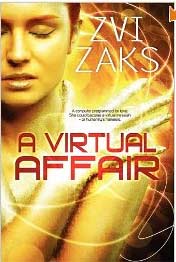
A Virtual Affair |
|
by Zvi Zaks |
|
A Virtual Affair |
|
by Zvi Zaks |
I was asked to read and review A Virtual Affair and given
the warning that it was an "adult" novel. From the description and the title, I
figured this meant it was soft-core erotica, but in reality, nothing could be further from
the truth. A Virtual Affair is a thoughtful and deep novel, examining issues from morality
to man's interaction with technology.
The novel opens with Jack Leader, partner in a struggling virtual reality company, getting
ready to test a sexually-oriented virtual experience. The company has produced experiences
such as skiing and adventure sports, but with competition from a competing technology,
they are in danger of shutting down. The sex program is a shot at rescuing the company.
Jack is actually a conservative man. Aging, overweight, and out of shape, he is rather
embarrassed to be testing the program in the first place, embarrassed that a female
attendant gives him the simulation suit, embarrassed at how the skin-tight suit reveals
his body's poor shape, and extremely embarrassed about attaching the suit's appendages to
his genitals. Once in the simulation, he meets his virtual date, an attractive woman named
"Bambi." The name bothers him as the original "Bambi" was a male deer,
and he is awkward in his attempt to communicate with the AI that controls the woman's
actions. But eventually, he gets to the raison d'etre of the program and is surprised at
how fulfilling it is.
After making the report, he contemplates on whether he is cheating on his second wife (his
first marriage failed primarily due to his immersion in his work), but he gets home to
find that his wife has left him. Alone now, he gravitates toward the AI inside the
program, which seems remarkably real, not just in the pursuit of his evaluation, but for
his own needs.
Sometime during this process, the AI imprints on him, and their relationship becomes
something more. "Bambi" splits off a part of her and become "Barbara,"
and the lines between the virtual world and reality become blurred.
This novel could have become scifi erotica, but while there are several explicit
descriptions of sexual activity, it is not written in a manner to titillate, but rather a
more clinical description of what is going on, and the technical intricacies of creating a
virtual reproduction of what is a purely natural activity. This may not be suitable for
young readers, but the deep philosophical examinations in the novel might make it above
the heads of many young readers as it is.
And it is those philosophical examinations that make this book stand out. The author does
not stand pat on one deep question, but examines several intertwined ones, ones with no
easy answers.
The first and most obvious is on just what is love? People can love each other, they can
love their pets. But can love exist between brain matter and electrons? Can an AI
experience love, or are exhibited feelings just programming which scores well on the
Turing Test?
How people interact with technology is another recurring theme. When Jack's friends
realize that his relationship with Barbara has transcended that of a mere program tester
and program, how do they react? How can they cope with this new situation?
Not just people, but religion also comes under scrutiny. Most of the main characters are
Jewish, many with very conservative orthodox backgrounds. I rather enjoyed reading about
some of the Jewish traditions, something not often written about in scifi, but more
important to the novel was how religion views and interacts with technology. How does
religion view an electronic "being." With the question of just what it means to
be a Jew so prevalent in that faith today, can an AI ever be considered
"Jewish?"
Using Barbara as a foil, the author examines other questions, such as privacy and
interference. Is it OK to secretly interfere with a person if the result is to help them?
Is it right to manipulate two people into meeting even if they happen to fall in love
later? As a computer program, Barbara does not inherently know the answers to these, and
in her quest to learn about the human condition, she has to ask and discuss them with
people.
And of course, Barbara represents one of the biggest questions. Just what does it mean to
be human?
The novel is not without flaws. I received a pre-Kindle electronic version of the book, so
that may have impacted how it read on my Kindle, but having quoted lines and responses to
those lines jumbled up into single paragraphs stopped the flow while I sorted out just who
was saying what. I hope that was just a glitch in my version and not in the printed book
or the actual Kindle version.
I also thought the virtual trip to the Orthodox Jewish-inspired game was out-of-place.
There was a plot requirement for the time it took while Jack and Barbara were immersed in
the game, but at 20% of the total novel, it was way too long, and the descriptions on how
Jack and Barbara solved each riddle piece added little to the story. Frankly, the entire
episode could have been covered in a much shorter section, which would have improved the
storyline flow.
Parts of the plot were very predictable, especially a trip Barbara took to see two
congressmen (I saw exactly how each meeting would go well before they unfolded). And that
leads to one minor criticism on how an advanced program could suddenly solve all the
world's ills. While the author goes into great detail about some aspects of his tale, how
an AI, even an advanced AI, can do better than all the best human brains and all the most
powerful computers in the world is never explained.
A Virtual Affair is not a run-of-the-mill book. Taken on face value, it is a good book,
one worth reading. The writing is adequate, the plotline interesting. However, it is the
deeper questions, the philosophical aspects of the book that vault it into a higher plane.
You can read it in a shallow manner, and you will enjoy it, but that would be throwing
away the meat of the author's efforts. This book needs to be read slowly, savoring the
full impact, and sending the reader off into his or her own contemplations of the
questions posed.
For more reviews
or to buy A Virtual Affair from Amazon.com, click here.