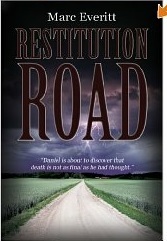
 |
Restitution Road |

|
by Marc Everitt |
Marc Everitt takes the time travel genre into new
territory, weaving an enjoyable story about a man who is given a second chance
at life and is asked to change history.
Daniel Lewis, at the end of his rope, decides to end it
all.
He wakes up, however, much to his surprise, where a well-dressed
gentleman is waiting for him.
Daniel can either remain dead, or he can perform three
tasks that need to be done in order to make sure history unfolds in a certain
way.
If he does this, he will be reunited with his son, who was taken away
when he and his wife divorced.
Daniel is a rather
likable character, but not for his character traits.
In fact, he is egotistical, stubborn, block-headed,
cowardly, rather dumb—the list goes on.
But the author gives him a sense of almost flippant
irreverency that strikes a chord.
Despite his flaws, he is someone with whom a reader can
connect.
Overall, the tone of
the book works quite well.
The author has a unique style and rhythm that imparts a
rather tasty flavor to the entire work.
There were issues with
the book, though, that detracted from the overall enjoyment.
Most of these can be attributed directly to poor copy
editing.
First, punctuation is
haphazard and confusing.
The comma is almost forgotten.
As the author tends to long, rambling sentences, the use
of commas would have greatly assisted in comprehension.
Capitalization
is also random, and while that does not interfere with comprehension, using
“Officer” and “officer” or “Sergeant” and “sergeant” in the same sentence
indicates a lack of attention to detail.
There were also
incorrect word choices, such as “less and less people.”
POV shifts also tended
to be haphazardly done.
One moment the reader is reading about Daniel, then it
shifts into the POV of another character without warning.
It takes further reading to realize this, making the
reader go back to get things into perspective.
More annoying were the
continuous errors of fact.
I started keeping a list of them.
I will only highlight a few here.
Daniel is first sent
back to the year 562 BC.
In what is now the UK, there are churches, and the
people speak modern English instead of Common Brythonic (no modern English
speaker would be able to understand that—although the “fix” for this would have
been easy given that Daniel was given increased abilities by his handler).
This era was also described as “Medieval England.”
The Battle of Waterloo
is of importance to the story.
At first, when Daniel recounted that Lord Nelson
defeated Napoleon, I thought that was just because Daniel was not the brightest
guy around.
But later, he researches the battle, and it is still Admiral
Nelson instead of the Duke of Wellington.
Daniel is also sent to
the Battle of the Somme.
In this section, he has soldiers eating and preparing
oil-boiled potatoes, something that probably never happened (Bully Beef and
biscuits were the staples in the trenches, and if potatoes were ever cooked,
they would never have been boiled in oil.)
People are put under with “sleeper holds” where they
stay out for 13 hours (and this can be somehow calculated.”
A folding knife with a seven inch blade can be thrown
effectively, and not only does it strike the target, but it pierces bone and
runs completely through the shoulder and out the back.
Crows use their feet to kill and carry off rats.
A person can “nerve pinch” another while quickly
passing, and that person will be unconscious for hours.
The errors like this
piled up.
There were a few other concerns, though, but those require a bit of a
spoiler.
SPOILER ALERT
Two issues stand out to me.
The first is that in this novel, God, angels, Lucifer,
and demons cannot directly interfere with what humans do, hence the need for
Daniel.
However, both in 562 BC England and in the Battle of the Somme, angels
take direct action against Daniel.
Lucifer arrives a few
moments too late to stop Uriel from assisting Daniel.
However, with Lucifer’s ability to travel through time,
couldn’t he just adjust this travel by a few minutes?
And with his ability, despite what Daniel does, he could
just got back and redo what was “fixed.”
END OF SPOILER ALERT
Part of the problem with writing time travel books
is accounting for the paradoxes and the “science” of it.
I think the author did a pretty good job at taking care
of these.
Some explanations were stronger than others, but there has to be some
literary license given to enable a storyline to develop.
Overall, this is a
very enjoyable book.
With better editing, I think this could be right at the
top of the genre.
I still recommend it as a new perspective of time travel.
For more reviews
or to buy this book from Amazon.com, click here.
Back