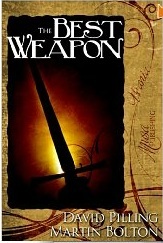
|
The Best Weapon |
|
by David Pilling and Martin Bolton |
|
The Best Weapon |
|
by David Pilling and Martin Bolton |
To me, most of the sword and sorcery fantasies follow the same storyline. The
Best Weapon, on the other hand, offers a new twist on the genre with a tale with
an original plot. In this world, gods are petty, selfish beings more intent on
their own position amongst the others. The Lords of Hell are twin demon
brothers, two scheming, conniving beings. When the brothers perceive an
approaching threat, their only recourse is to create two brothers out of clay
and place them into the wombs of woman at opposite sides of the world where they
will grow and mature until the demon brothers can make use of them.
One brother, Naiyar, is born into the Djanki tribe, a fierce, warlike people,
bent on conquest. The other brother, Fulk, is born to a woman in the far north
where the remnants of the Old Kingdom have taken root. Orphaned at an early age,
he is taken in by the Knights Templar, and ancient order dedicated to supporting
the rightful king. Or at this time, the infant queen, the king recently dying
with no male heir. Through trials and tribulations, events point to the brothers
meeting, but what they might do then is unknown.
The rhythm and tempo of the book flows well, despite bouncing back and forth
between the two brothers and some assorted characters such as the Archpriest
Flambard, the regent of the Old Kingdom. The character voice is appropriate, and
the details of this world are well thought-out and logical.
One point I liked was the transformation of the Archpriest from a scheming, but
not horrible man, to someone evil after being "touched" by one of the Lords of
Hell. With only a few sentences here and there, the fact that this is a
transformation out of the Archpriest's control is evident.
I also liked the fact that the various characters had their own individual
voices and speech patterns. Too often, each character in a book speaks with one
voice, that of the author. But in this book, I could read a quote and recognize
the character. The two brothers, in particular, ahd their own identities (I
wondered that as the book has two authors, if each one took one of the brothers
and penned his dialogue.) Of course, by making them different, they came across
differently. I felt that of the two, Naiyar was the more colorful, complete, and
complex character.
William Mallet, the Master-at-Arms for the Templars was perhaps my favorite
character. Initially seeming to be a callous tyrant, the authors gradually
coaxed out a fuller picture of an honorable and brave man. We were never
directly told this, but his true character was revealed by his actions.
The language was slightly stilted, as is common in this genre, but not overly
so. I also had a problem with people blindly following the Archpriest when his
physical condition had deteriorated. But overall, this was a very enjoyable,
captivating novel. I heartily recommend it to anyone.
For more reviews
or to buy The Best Weapon from Amazon.com, click here.